This June, the books on our shelves invite you to explore South Carolina’s great outdoors, from its natural beauty to the historic landscapes where the American Revolution unfolded. Discover state parks that preserve Revolutionary history, along with guides that encourage you to hike, bike, kayak, and experience the Palmetto State’s scenic outdoors firsthand.
Great Outdoors Month on our Shelves
On the Shelves

The Archaeology of the American Revolution
This volume takes a holistic approach to the American Revolutionary War era, drawing on perspectives from archaeology and related disciplines to illuminate the multifaceted nature of the conflict.

Parker's Guide to the Revolutionary War in South Carolina: Battles, Skirmishes and Murders
Parker's Guide describes the wheres, with the whats and the whens of the known actions in South Carolina. Some of the actions are undocumented because the records were lost or the participants were illiterate. Parker's Guide takes you to the actual places where these historic events unfolded.

Touring South Carolina’s Revolutionary War Sites
The 21 tours in this book tell about Revolutionary War South Carolina at the sites where events occurred - at the homes of participants, on battlefields, at the graves of men and women who sacrificed for freedom.

Plantations and Outdoor Museums in America’s Historic South
Seasoned travel writers Gerald and Patricia Gutek believe the American South is for history enthusiasts what Ghiradelli's is for chocolate connoisseurs, and with their latest guidebook they invite travelers of all ages to sample what life was once like in this beguiling region. As they did in their popular guide Experiencing America's Past, the Guteks introduce readers to the pleasures of exploring historic America―this time turning their travel know-how to the preserved and restored plantations and museum villages that grace the Southern landscape.
From the Great River Road Plantations between Baton Rouge and New Orleans to Montpelier Mansion in Virginia, these plantations and villages demonstrate how people lived, worked, prayed, and played decades and centuries ago. In their easy-to-use guide, the Guteks tell how to visit and enjoy sixty-eight such gems of the Old South.

William Bartram and the American Revolution on the Southern Frontier
Title: William Bartram and the American Revolution on the Southern Frontier
Author: Edward J. Cashin
Description: In Travels, the celebrated 1791 account of the "Old Southwest," William Bartram recorded the natural world he saw around him but, rather incredibly, omitted any reference to the epochal events of the American Revolution. Edward J. Cashin places Bartram in the context of his times and explains his conspicuous avoidance of people, places, and events embroiled in revolutionary fervor.
Cashin suggests that while Bartram documented the natural world for plant collector John Fothergill, he wrote Travels for an entirely different audience. Convinced that Providence directed events for the betterment of mankind and that the Constitutional Convention would produce a political model for the rest of the world, Bartram offered Travels as a means of shaping the new country. Cashin illuminates the convictions that motivated Bartram—that if Americans lived in communion with nature, heeded the moral law, and treated the people of the interior with respect, then America would be blessed with greatness.
In addition Cashin offers a detailed portrait of the often overlooked southern frontier on the eve of the Revolutionary War, revealing it to have been a coherent entity united by an uneasy coexistence of Native Americans and British colonials.

Fields of Vision: Essays on the Travels of William Bartram
William Bartram was a naturalist, artist, and author of Travels through North and South Carolina, Georgia, East and West Florida, the Cherokee Country, the ExtensiveTerritories of the Muscogulees, or Creek Confederacy, and the Country of the Choctaws. The book, based on his journey across the South, reflects a remarkable coming of age. In 1773, Bartram departed his family home near Philadelphia, Pennsylvania, as a British colonist; in 1777, he returned as a citizen of an emerging nation of the United States. The account of his journey, published in 1791, established a national benchmark for nature writing and remains a classic of American literature, scientific writing, and history. Brought up as a Quaker, Bartram portrayed nature through a poetic lens of experience as well as scientific observation, and his work provides a window on 18th-century southern landscapes. Particularly enlightening and appealing are Bartram’s detailed accounts of Seminole, Creek, and Cherokee peoples.
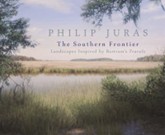
Philip Juras: The Southern Frontier: Landscapes Inspired by Bartram’s Travels
Presenting stunning reproductions of oil paintings by landscape artist Philip Juras, this exhibition catalogue offers a glimpse of the presettlement southern wilderness as late eighteenth-century naturalist William Bartram would have experienced it during his famed travels through the region. Juras’s work combines direct observation with historical, scientific, and natural history research to depict, and in some cases reimagine, landscapes as they appeared in the 1770s. Juras spent years researching Bartram and revisiting important sites the naturalist wrote about in his celebrated Travels. Juras’s paintings recreate the lost southern frontier for contemporary viewers in much the same way that nineteenth century American landscape painters like Albert Bierstadt and Thomas Moran brought the western frontier to the consciousness of the rapidly industrializing East.
Juras’s work explores many of the important and imperiled ecosystems that remain in the South today. These little-known, remnant natural communities, depicted in well-researched and meticulous paintings, are further illuminated by essays placing them in the context of Bartram’s legacy and the American landscape movement.

American Sportsmen and the Origins of Conservation
Environmentalists who believe that hunters and anglers are interested only in the kill and the catch may be surprised to learn that sportsmen were originally in the vanguard of the conservation movement. John Reiger's work has been hailed as an authoritative look at these early conservationists; now his landmark book is available in an expanded edition that broadens its historic sweep.
Praised as "one of the seminal works in conservation history" by historian Hal Rothman, Reiger's book continues to be essential reading for all concerned with how earlier Americans regarded the land, demonstrating even to those who oppose hunting that they share with sportsmen and sportswomen an awareness and appreciation of our fragile environment.

American Earth: Environmental writing since Thoreau
As America and the world grapple with the consequences of global environmental change, the author, a writer and activist offers this anthology gathering the best and most significant American environmental writing from the last two centuries. "Each advance in environmental practice" in our nation's history, he observes in his introduction, "was preceded by a great book." In this work are the words that made a movement. Classics of the environmental imagination, the essays of Henry David Thoreau, John Muir, and John Burroughs; Aldo Leopold's A Sand County Almanac; Rachel Carson's Silent Spring, are set alongside an emerging activist movement, revealed by newly uncovered reports of pioneering campaigns for conservation, passages from landmark legal opinions and legislation, and searing protest speeches. Throughout, some of America's greatest and most impassioned writers take a turn toward nature, recognizing the fragility of our situation on earth and the urgency of the search for a sustainable way of life. The anthology includes essays on overpopulation, consumerism, energy policy, and the nature of "nature" join ecologists' memoirs and intimate sketches of the habitats of endangered species, as well as a detailed chronology of the environmental movement and American environmental history.

America’s Public Lands: From Yellowstone to Smokey Bear and Beyond
How is it that the United State—the country that cherishes the ideal of private property more than any other in the world—has chosen to set aside nearly one-third of its territory as public lands? Considering this intriguing question, Randall K. Wilson traces the often-forgotten ideas of nature that have shaped the evolution of America’s public land system. The result is a fresh and probing account of the most pressing policy and management challenges facing national parks, forests, rangelands, and wildlife refuges today.

Wilderness by Design: Landscape Architecture and the National Park Service
Tracing the history of landscape park design from British gardens up through the city park designs of Frederick Law Olmsted, Ethan Carr places national park landscape architecture within a larger historical context. Despite the difficulties now confronting the parks, their continued ability to attract millions of visitors suggests that their creators succeeded in presenting a captivating vision of a once-wild America.
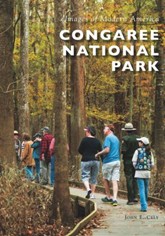
Congaree National Park
Located in central South Carolina, only a few miles from the capital city of Columbia, Congaree National Park is the largest old-growth bottomland hardwood forest left in the country and one of the most biologically diverse parks within the national park system. Nearly 100 species of trees have been documented within the park, almost as many as in the entire Pacific Northwest. The park has one of the tallest hardwood forests anywhere in the temperate world and features numerous trees of record-setting proportions, a distinction that has earned it the name "Forest of Champions." This book discusses the early history of the area that later became the Congaree National Park, shows efforts to protect it from logging by a citizen's grassroots campaign, traces the park's early beginnings and development, and illustrates some of the park's notable flora and fauna.

Exploring South Carolina State Parks: A Guide to the State Parks in South Carolina
: Best-selling authors J.L. and Lin Stepp so enjoyed visiting all the state parks in their home state of Tennessee, while writing their award-winning book Discovering Tennessee State Parks, that they decided to spread their wings and visit all the parks in South Carolina, too. The result is Exploring South Carolina State Parks, a guidebook providing detailed descriptions of each of the forty-seven state parks, along with descriptions of eight of South Carolina's national parks and historic sites. In a format similar to their Tennessee parks guide and their best-selling Smoky Mountain hiking guide, The Afternoon Hiker, the Stepps provide clear directions to get to every park, suggestions for interesting things to do and see while visiting or camping, tips and local insights about the area, and over 700 color illustrations to showcase the beauty of every park visited. The book is divided into four South Carolina regions, the Lowcountry, Midlands, Pee Dee, and Upstate. Each regional section has its own index and at the end of the book is a colorful map and an alphabetical index to help readers easily locate any park of interest. Based on the authors' own explorations and travels throughout South Carolina, this guide offers a detailed personal account of the diverse and picturesque parks, all rich with history and beauty. So pack your bags and get ready for some fun looking through this guide and planning your upcoming trip to The Palmetto State.
Upcoming Event

Speaker at the Center Series: Historyman Comics author, Eric K. Barnes, discusses "An Army of a Different Kind"
August 27, 2026, 6:00 PM
Please join us for our next Speaker at the Center talk with Historyman, Eric Barnes, who is on the trail of our American history through a number of projects, including the Historyman Podcast, Historyman blog, and Historyman Comics. These projects seek to illustrate and educate future generations about the challenges of the past, the hard-fought victories, and the visionary hopes of those who went before us.